


Linear bearing types should not be selected by shaft diameter alone. Bearings with the same bore size may have different outer structures, mounting methods, flange shapes and shaft-support requirements. A model that fits the shaft may still be unsuitable for the machine structure.
Common options include standard cylindrical bearings, open type bearings, round flange bearings, square flange bearings, oval flange bearings, long type bearings and housed bearing units. These options are available in the DLY linear bearing range for round-shaft motion systems.
Most of these bearings use a similar rolling principle, but their installation structures are different. For details about the load zone and ball return path, see how a linear bearing works. The selected bearing should also be matched with a suitable linear shaft.
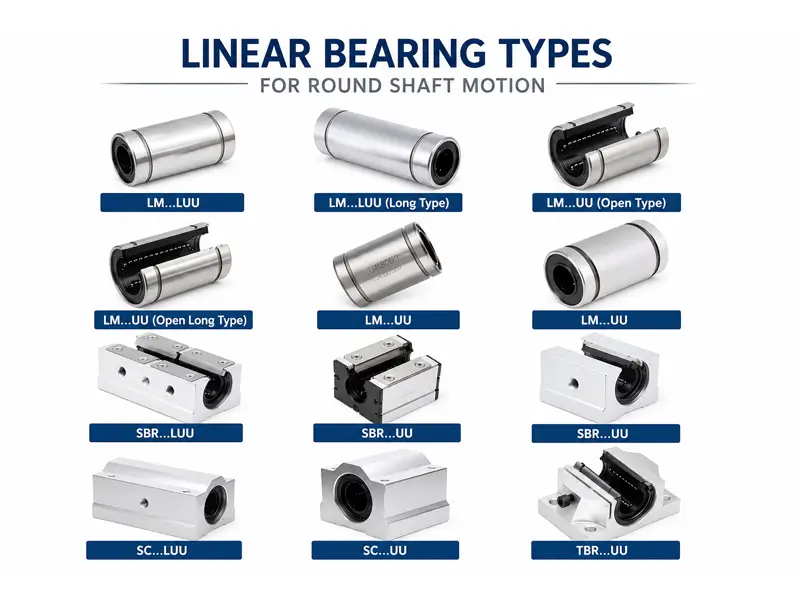
Common linear bearing and housed bearing configurations for round-shaft motion systems
Linear Bearing Basics
A linear bearing guides straight-line movement along a round shaft. The bearing may be installed inside a separate housing, mounted directly through a flange or supplied as part of an assembled aluminum bearing block.
The main difference between linear bearing types is therefore not simply how the balls move. The more important selection questions are:
- Is the shaft supported only at the ends or continuously along its length?
- Will the bearing be pressed into a housing or bolted to a mounting plate?
- How much width and mounting height are available?
- Does the moving part need a short bearing, long bearing or complete bearing unit?
- Are there special requirements for clearance, sealing, smoothness or precision?
Quick Selection
| Bearing Type | Shaft Arrangement | Mounting Method | Suitable Situation | Main Point to Confirm |
|---|---|---|---|---|
| Standard cylindrical bearing | Round shaft without continuous support below | Installed inside a separate housing or machine bore | General automation and compact round-shaft systems | Housing bore, retaining method and bearing length |
| Long type bearing | Usually used on an end-supported round shaft | Installed inside a longer housing or bore | Moving parts requiring longer bearing contact and improved guidance | Available installation length and alignment |
| Open type bearing | Continuously supported shaft or supported rail | Installed with its opening aligned to the shaft support | Longer travel where shaft bending must be reduced | Opening direction and support-rail dimensions |
| Round flange bearing | Normally used with a round shaft without continuous support | Bolted directly to a plate through a round flange | Compact direct mounting with a symmetrical bolt pattern | Flange diameter, bolt circle and overall length |
| Square flange bearing | Normally used with a round shaft without continuous support | Bolted to a flat plate through four corner positions | Stable mounting on automation plates and machine frames | Flange width and mounting-hole spacing |
| Oval flange bearing | Normally used with a round shaft without continuous support | Bolted through two mounting sides | Narrow installation positions and compact machine structures | Mounting direction and two-hole spacing |
| Housed bearing unit | Closed or open structure, depending on the unit | Complete block bolted to the moving plate | Faster installation without machining a separate bearing housing | Block height, mounting-hole spacing and open or closed design |
Standard Cylindrical Bearings
Standard cylindrical linear bearings, including common LM and LME dimensional families, have a round outer body without an integrated mounting flange. The bearing is normally inserted into a housing, aluminum block or accurately machined bore.
This structure gives the machine designer flexibility to create a compact housing around the bearing. It is commonly used when the equipment already has a suitable bearing seat or when the housing is part of the moving component.
The bearing should not be held by excessive housing interference. Too much compression may reduce internal clearance and make movement tight. The housing should also provide a suitable retaining method so the bearing cannot shift axially during repeated motion.

Standard cylindrical linear bearing for installation inside a housing or machine bore
Long Type Bearings
A long type linear bearing has a greater overall bearing length than the corresponding standard model. The longer contact length can improve guidance stability and reduce angular movement of the mounted component.
A long bearing is useful when there is enough axial installation space but limited room for two separate bearings. However, it does not correct poor shaft alignment. Longer bearings can be more sensitive to parallelism and housing-bore errors, so installation accuracy still matters.
Open Bearings for Supported Shafts
An open type linear bearing has an axial opening in the bearing body. The opening passes over the support structure underneath a continuously supported shaft.
This design is normally selected when the travel is long enough for shaft deflection to become a concern. Supporting the shaft along its length increases system stability compared with a shaft supported only at its ends.
The opening of the bearing must face the shaft support. A closed cylindrical bearing cannot pass over a continuous support rail, even when its bore diameter matches the shaft.

Open type linear bearing with an axial opening for the shaft-support structure
Flanged Bearings
A flanged linear bearing combines the bearing body with an integrated mounting flange. Instead of machining a full cylindrical housing, the flange can be bolted directly to a plate, bracket or moving component.
Round, square and oval flange bearings may use the same nominal shaft diameter, but their flange dimensions and mounting-hole patterns are different. They should not be treated as automatically interchangeable.

Round, square and compact flange structures for direct plate mounting
Round Flange Linear Bearing
A round flange provides a symmetrical mounting shape around the bearing body. It is suitable for compact direct mounting and structures where a circular flange fits naturally around the shaft axis.
Before ordering, confirm the flange outside diameter, bolt-circle diameter, hole quantity, bearing length and whether the flange is located at the end or in the middle of the bearing body.
Square Flange Linear Bearing
A square flange provides four clear corner mounting positions and a broad reference face. It is commonly used on flat machine plates, automation frames and moving brackets where stable four-point bolt fixing is preferred.
The square shape usually requires more width than an oval flange. The mounting plate must have enough clearance for the flange corners and bolt heads.
Oval Flange Linear Bearing
An oval flange removes the unnecessary corner area of a square flange and uses two main mounting sides. This makes it useful where the installation width is limited or where the machine structure requires a clear mounting direction.
The oval structure is not simply a decorative variation. Its main value is fitting a flange-mounted bearing into a narrower plate or compact assembly while retaining direct bolt mounting.
| Flange Shape | Main Benefit | Typical Mounting Condition | Dimension to Check |
|---|---|---|---|
| Round | Symmetrical and compact around the shaft axis | Circular or compact direct-mounting position | Flange diameter and bolt circle |
| Square | Broad reference face and four-corner fixing | Flat automation plate or machine frame | Flange width and hole spacing |
| Oval | Reduced width and clear mounting direction | Narrow plate or compact equipment structure | Overall width and two-hole spacing |
Housed Bearing Units
A housed linear bearing unit combines a linear bearing with a machined aluminum or metal block. The unit can be bolted directly to a moving table, carriage or machine plate without designing a separate cylindrical bearing seat.
Closed housed units are commonly used with round shafts supported at their ends. Open housed units are used with continuously supported shafts or supported rail assemblies.
Common unit configurations include closed SC-type blocks and open SBR- or TBR-type blocks. Model naming and dimensions should be confirmed from the relevant drawing because block height, width, hole spacing and bearing length can differ.
Housed units reduce machining and assembly work, but they also define the installed center height. When replacing an existing unit, the mounting-hole pattern and shaft-center height are just as important as the shaft diameter.
Closed and Open Structures
Closed Linear Bearing
The bearing surrounds the shaft without an opening for a continuous support rail.
Select it for shafts supported at the ends or for structures where there is no support profile directly underneath the bearing travel path.
Open Linear Bearing
The bearing has a longitudinal opening that passes over the shaft-support structure.
Select it for continuously supported shafts, especially where longer travel or higher resistance to shaft bending is required.
Shaft and Mounting Match
A correctly selected bearing type can still perform poorly when the shaft or mounting structure is unsuitable. The shaft diameter must match the bearing bore, while shaft hardness, surface condition, straightness and support method affect smoothness and wear.
A normal soft steel rod is not an ideal substitute for a hardened linear shaft. A soft, rough or bent shaft may create rapid wear, noise and unstable movement.
For two-shaft systems, the shafts and bearing housings must be installed parallel to each other. Forcing misaligned bearings onto the shafts can create excessive running resistance even when every individual component has the correct nominal size.

Round-shaft motion system using linear bearing blocks, shafts and end supports
Selection Factors
1. Confirm the Shaft Support Method
Determine whether the shaft is supported only at its ends or continuously along its length. This decision normally determines whether a closed or open bearing structure is required.
2. Confirm the Mounting Structure
Select a standard cylindrical bearing when the machine already has a suitable housing. Select a flange type when the bearing must bolt directly to a plate. Select a housed unit when faster assembly and a defined mounting block are preferred.
3. Match the Bore and External Dimensions
The bearing bore must match the nominal shaft diameter. Also confirm the outside diameter, bearing length, flange dimensions, mounting-hole pattern and shaft-center height. The same shaft size does not guarantee the same external dimensions.
4. Check Load Direction and Moment
Linear bearings are mainly intended to support radial loads along a round shaft. Strong overturning moments should not be carried by one short bearing alone. Increasing the distance between two bearings or using a longer bearing arrangement can improve stability.
Load rating can vary with the orientation of the internal ball circuits. For applications close to the rated capacity, confirm the load direction and dynamic load rating from the relevant model data.
5. Check Travel Length and Shaft Deflection
Longer travel does not automatically require a larger bearing, but it can increase shaft-deflection risk. When an end-supported shaft bends excessively, an open bearing with a continuously supported shaft may provide a more stable structure.
6. Check the Working Environment
Dust, cutting chips, moisture, temperature and lubrication conditions should be reviewed before confirming the bearing. Seals can help reduce contaminant entry, but they do not replace external covers or regular maintenance in heavily contaminated environments.
Application Examples
Common Selection Errors
- Checking only the shaft diameter: bearings with the same bore can have different outside dimensions, lengths and mounting structures.
- Using a closed bearing on a supported shaft: the bearing cannot pass over the continuous shaft-support profile.
- Assuming flange shapes are interchangeable: round, square and oval flanges have different outlines and bolt patterns.
- Ignoring shaft-center height: replacement bearing blocks may fit the shaft but place the moving plate at a different height.
- Using one short bearing for a strong moment load: bearing spacing and carriage structure also affect stability.
- Ordering the bearing without confirming matched parts: shaft supports, housings, supported rails and retaining components should be checked together.
Ordering Checklist
| Information | What to Provide | Why It Matters |
|---|---|---|
| Existing model | Complete model number, label or clear product photo | Helps identify the dimensional family and structure |
| Shaft diameter | Nominal diameter in millimetres | Determines the bearing bore size |
| Bearing structure | Standard, long, open, flanged or housed | Matches the bearing to the machine structure |
| Flange shape | Round, square or oval, including hole spacing | Prevents mounting-pattern mismatch |
| Shaft support | End-supported shaft or continuously supported shaft | Determines whether a closed or open bearing is required |
| Installation dimensions | Outside diameter, length, center height and mounting-hole positions | Confirms physical interchangeability |
| Application conditions | Load, travel, speed, orientation and environment | Helps confirm bearing length, sealing and support method |
| Order information | Quantity, matched parts, destination and packaging requirements | Supports accurate quotation and delivery planning |
FAQ
Q: What is the main difference between closed and open linear bearings?
A: A closed bearing is used where no continuous shaft support passes underneath the bearing. An open bearing has an axial opening that allows it to travel over the support profile of a continuously supported shaft.
Q: What is the difference between round, square and oval flange bearings?
A: The main difference is the mounting shape. Round flanges provide a symmetrical structure, square flanges provide a broad four-corner mounting face, and oval flanges reduce installation width for narrower mounting positions.
Q: When should a long type linear bearing be selected?
A: A long bearing can be selected when greater bearing contact length and improved guidance stability are needed, especially where there is enough axial installation space but insufficient room for two separate bearings.
Q: Can two bearings with the same bore diameter replace each other?
A: Not necessarily. The outside diameter, length, flange dimensions, mounting holes, center height and open or closed structure must also match.
Q: Can a linear bearing run on an ordinary steel rod?
A: A hardened and properly finished linear shaft is recommended. Ordinary soft steel rods may wear quickly and can cause rough movement, noise or unstable clearance.
Q: When may a round-shaft bearing system be unsuitable?
A: Applications with high overturning moments, very high rigidity requirements or demanding positioning stability may require a profile rail and block system rather than a basic round-shaft bearing arrangement.
Q: What information is needed for a linear bearing quotation?
A: Send the model number or shaft diameter, bearing structure, flange style, mounting dimensions, quantity and application information. A drawing or clear sample photo is useful for replacement orders.
Summary
The main linear bearing types are standard cylindrical bearings, long type bearings, open bearings, round flange bearings, square flange bearings, oval flange bearings and housed bearing units.
Standard cylindrical bearings suit machines with a separate bearing housing. Open bearings are required for continuously supported shafts. Flange bearings simplify direct plate mounting, while housed units reduce housing design and assembly work.
Final selection should confirm the shaft diameter, shaft-support method, bearing structure, flange dimensions, mounting holes, center height, travel, load direction and working environment. Choosing by bore size alone is not enough.
Linear Bearing Selection Support
Send the shaft diameter, bearing model, flange shape, installation dimensions, quantity or equipment drawing. DLY can help check the bearing type and matched round-shaft components before quotation.
Email: export@dlybearing.com
Contact DLY


