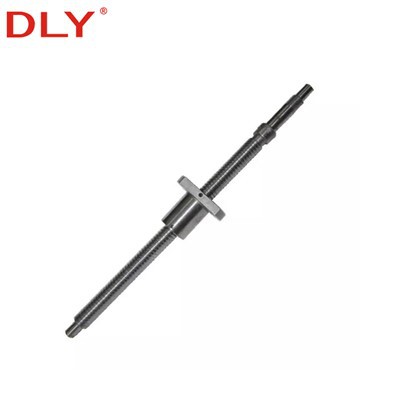
Hey there! As a ball screws supplier, I've been in the thick of the manufacturing game for quite a while. Quality control in ball screw manufacturing is super crucial, and I'm gonna share some of the key measures we take to make sure our products are top - notch.
Material Selection
First off, the quality of a ball screw starts with the materials we use. We don't just grab any old metal off the shelf. We source high - grade steel that has the right balance of hardness, toughness, and corrosion resistance. This steel is carefully inspected when it arrives at our facility. We check for any surface defects, like cracks or pits, that could affect the performance of the final product.
We also test the chemical composition of the steel. This is done through advanced analytical techniques. By ensuring the right mix of elements, we can guarantee that the ball screw will have the strength and durability needed for various applications. For instance, if a ball screw is going to be used in a high - speed machine, it needs to be able to withstand the stress without deforming. Using the wrong material could lead to premature failure, and that's not something we want to happen.
Machining Precision
Once we have the right material, it's time to start machining. Precision is the name of the game here. We use state - of - the - art CNC (Computer Numerical Control) machines to cut and shape the ball screws. These machines are programmed to extremely tight tolerances. For example, the pitch of the screw thread, which is the distance between adjacent threads, needs to be accurate to within a few micrometers.
During the machining process, we have in - process inspections. Our quality control team uses measuring tools like micrometers and calipers to check the dimensions of the ball screw at various stages. If the measurements are off even by a tiny bit, we can make adjustments right away. This helps us avoid producing defective parts and saves a lot of time and resources in the long run.
We also pay close attention to the surface finish of the ball screw. A smooth surface is essential for reducing friction and wear. After machining, we use polishing techniques to achieve the desired surface roughness. This not only improves the performance of the ball screw but also extends its service life.
Heat Treatment
Heat treatment is another critical step in the manufacturing process. It helps to enhance the mechanical properties of the ball screw. We use processes like quenching and tempering to harden the steel and improve its toughness.
During heat treatment, we have strict temperature and time controls. The temperature needs to be maintained within a very narrow range to ensure that the steel is properly hardened. If the temperature is too high, the steel could become brittle, and if it's too low, it won't be hard enough.
After heat treatment, we perform hardness testing. We use hardness testers to measure the hardness of the ball screw at different points. This ensures that the heat treatment process has been successful and that the ball screw meets our quality standards.
Ball and Nut Assembly
The assembly of the balls and the nut is a delicate process. The balls need to be evenly distributed within the nut to ensure smooth operation. We use special equipment to load the balls into the nut.
Before assembly, we inspect the balls for any defects. They should be perfectly round and have a consistent size. Any balls that don't meet our criteria are rejected.
Once the balls are loaded, we check the preload of the ball screw. Preload is the force applied to the balls to eliminate play between the screw and the nut. It's important to get the preload just right. Too much preload can increase friction and power consumption, while too little preload can lead to backlash and reduced accuracy.
Final Inspection
After the ball screw is fully assembled, it goes through a final inspection. We use a combination of visual inspection and functional testing.
For visual inspection, we look for any cosmetic defects like scratches or dents. Even though these may not directly affect the performance of the ball screw, they can be a sign of poor manufacturing processes.
Functional testing is where we really put the ball screw to the test. We use test benches to simulate real - world operating conditions. We measure parameters like axial play, torque, and efficiency. If the ball screw doesn't meet our performance criteria during functional testing, it's sent back for rework or, if necessary, scrapped.
Testing with Related Products
We also test our ball screws in conjunction with other related products. For example, we test them with Supported Linear Rail Shaft and 10mm Linear Rod. This helps us ensure that our ball screws work seamlessly with these products in a complete system.
We also test the ball screws with Linear Ball Bearing Slide Block. By doing so, we can evaluate the overall performance of the system and make any necessary adjustments to our ball screws.


Documentation and Traceability
Throughout the manufacturing process, we keep detailed records. Every ball screw has a unique identification number, and we document all the manufacturing steps, inspection results, and test data associated with it.
This documentation is not only important for quality control but also for traceability. If there is ever an issue with a ball screw in the field, we can quickly trace back its manufacturing history. This allows us to identify the root cause of the problem and take appropriate corrective actions.
Continuous Improvement
Quality control is not a one - time thing. We are constantly looking for ways to improve our manufacturing processes and quality control measures. We collect feedback from our customers and use it to make changes to our products and processes.
We also stay up - to - date with the latest industry standards and technologies. By investing in research and development, we can ensure that our ball screws remain at the forefront of the market in terms of quality and performance.
If you're in the market for high - quality ball screws, I'd love to have a chat with you. Whether you need ball screws for a small - scale project or a large - scale industrial application, we've got you covered. Reach out to us to start a discussion about your specific requirements and how our ball screws can meet them.
References
- "Manufacturing Engineering and Technology" by Serope Kalpakjian and Steven R. Schmid
- Industry standards and guidelines related to ball screw manufacturing