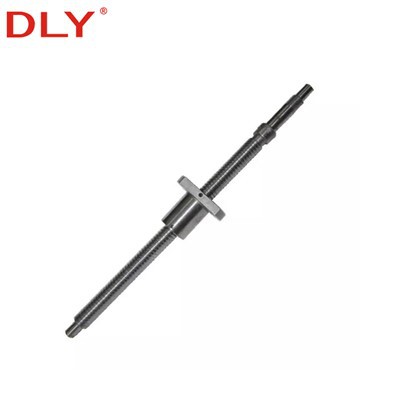
As a supplier of linear shafts, I often encounter questions from customers about the capabilities of our products. One of the most frequently asked questions is whether a linear shaft can withstand torsional loads. In this blog post, I will delve into this topic and provide a comprehensive answer based on scientific principles and real - world applications.
Understanding Linear Shafts
Linear shafts are fundamental components in many mechanical systems. They are designed primarily to provide a smooth and precise linear motion. Our company offers a wide range of linear shafts, including the 10mm Linear Rod and 12mm Linear Shaft, as well as Round Linear Shafting. These shafts are typically made from high - quality materials such as stainless steel or carbon steel, which are chosen for their strength, durability, and corrosion resistance.
The main function of a linear shaft is to guide a moving component along a straight path. It works in conjunction with linear bearings, which reduce friction and allow for efficient movement. Linear shafts are commonly used in applications such as automation equipment, CNC machines, 3D printers, and robotics.
Torsional Loads Defined
Torsional loads refer to the twisting forces applied to a shaft. When a torque is applied to a shaft, it causes the shaft to rotate about its axis. Torsional loads can be generated by various factors, such as the operation of motors, gears, or pulleys. In some applications, these loads can be significant and may pose a challenge to the structural integrity of the shaft.
Can a Linear Shaft Withstand Torsional Loads?
The short answer is that it depends. Linear shafts are not typically designed to withstand high torsional loads. Their primary design focus is on providing linear support and guiding functions. However, under certain conditions, they can tolerate some level of torsional stress.
-
Material Properties
-
The material of the linear shaft plays a crucial role in its ability to withstand torsional loads. For example, stainless steel has good strength and ductility, which allows it to absorb some torsional stress without fracturing. Carbon steel, on the other hand, can be heat - treated to increase its hardness and strength, enhancing its torsional resistance. However, even with these strong materials, the torsional capacity of a linear shaft is still limited compared to shafts specifically designed for torsional applications, such as drive shafts.
-
Shaft Geometry
-
The diameter and length of the linear shaft also affect its torsional performance. A thicker shaft generally has a higher torsional strength because it has a larger cross - sectional area. The polar moment of inertia, which is a measure of a shaft's resistance to torsion, is proportional to the fourth power of the shaft's radius. Therefore, increasing the diameter of the shaft can significantly improve its torsional capacity. Additionally, a shorter shaft is less likely to experience excessive twisting compared to a longer one, as the torsional stress is distributed over a shorter length.


-
Load Magnitude and Duration
The magnitude and duration of the torsional load are important factors. If the torsional load is relatively small and applied for a short period, the linear shaft may be able to withstand it without significant damage. However, if the load is large and continuous, it can cause the shaft to deform or even break. For example, in a light - duty 3D printer, the torsional loads generated during normal operation may be minimal, and the linear shaft can handle them without issues. But in a high - speed industrial machine with powerful motors, the torsional loads can be much higher and may exceed the capacity of a standard linear shaft.
Real - World Considerations
In real - world applications, it is essential to assess the potential torsional loads accurately. If a linear shaft is expected to experience significant torsional stress, it may be necessary to take additional measures.
-
Reinforcement
One option is to reinforce the linear shaft. This can be done by adding a keyway or a spline to the shaft. A keyway allows for the use of a key, which can transfer some of the torsional load from the shaft to the connected component. A spline provides a more continuous connection and can distribute the torsional stress more evenly. -
Alternative Shaft Designs
In some cases, it may be more appropriate to use a shaft specifically designed for torsional loads. For example, a solid or hollow drive shaft can be used instead of a linear shaft. These shafts are engineered to handle high - torque applications and have a much higher torsional capacity. -
Load Distribution
Proper load distribution can also help reduce the torsional stress on a linear shaft. By using multiple shafts or bearings to share the load, the stress on each individual shaft can be minimized. This can be achieved through careful design and the use of appropriate mechanical components.
Applications Where Torsional Loads May Be Present
There are some applications where linear shafts may be exposed to torsional loads.
-
Robotics
In robotic arms, linear shafts are used to guide the movement of various components. When the robot performs complex motions, such as rotating or twisting, torsional loads can be applied to the linear shafts. In these cases, it is important to ensure that the shafts can handle the additional stress. -
Automated Conveyor Systems
In conveyor systems, linear shafts are used to support and guide the movement of the conveyor belts. If the conveyor system experiences sudden starts or stops, or if there are misalignments in the pulleys, torsional loads can be generated. These loads need to be considered when selecting the appropriate linear shafts for the system.
Conclusion
In conclusion, while linear shafts are not designed primarily for torsional loads, they can tolerate some level of torsional stress depending on factors such as material properties, shaft geometry, and load magnitude. As a supplier of linear shafts, we understand the importance of providing our customers with accurate information to make informed decisions.
If you are unsure whether a linear shaft is suitable for your application with torsional loads, we encourage you to contact us for further discussion. Our team of experts can help you assess your requirements and recommend the most appropriate solution. Whether you need a 10mm Linear Rod, 12mm Linear Shaft, or Round Linear Shafting, we are here to support you in your procurement process. Reach out to us to start a conversation about your specific needs and explore the best options for your project.
References
- Budynas, R. G., & Nisbett, J. K. (2011). Shigley's Mechanical Engineering Design. McGraw - Hill.
- Juvinall, R. C., & Marshek, K. M. (2006). Fundamentals of Machine Component Design. Wiley.
-
Phone Number/Whatsapp:+8618957070963
Email:export@dlybearing.com
YOUTUBE:youtube.com/%40DLYlinearmotion
Facebook:www.facebook.com/DLYLinearMotion
Website:www.deliyalinearmotion.com