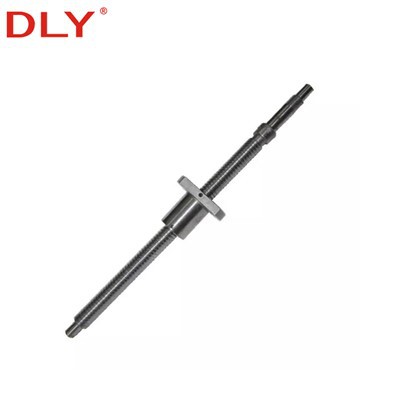
Heavy Duty Ball Screw for High Load Industrial Linear Motion
A heavy duty ball screw is designed for industrial equipment where the linear motion system must carry higher axial load, maintain rigidity, and run reliably under repeated working cycles. It is commonly used in large CNC machines, press equipment, injection molding machines, lifting axes, heavy automation systems, and other machines where ordinary small-diameter ball screws may not provide enough load capacity.
DLY supplies heavy load ball screws with large diameter options, reinforced nut structures, custom length, end machining, and model selection support. For buyers, the key is not only choosing a larger screw, but also confirming load direction, stroke length, lead, support method, nut structure, and installation rigidity.
What Makes a Ball Screw Suitable for Heavy Duty Use?
A heavy duty ball screw is not defined only by a larger diameter. In real equipment, heavy duty performance depends on the combination of screw diameter, lead, nut structure, preload, support bearing arrangement, raceway hardness, lubrication, and machine frame rigidity.
When the system carries high axial force or moves a heavy worktable, the screw must resist deformation and maintain stable feed movement. If the diameter is too small, the support method is weak, or the nut clearance is not suitable, the machine may suffer from vibration, positioning drift, abnormal noise, or shortened service life.
Higher Axial Load Capacity
Larger diameter and proper nut structure help the screw carry heavier feed force and machine load.
Better Rigidity Under Load
A heavy load axis needs enough screw rigidity to reduce deflection and maintain stable motion accuracy.
Reliable Long-Term Operation
Correct preload, lubrication and support bearing design help extend service life in continuous industrial use.
Heavy Duty Ball Screw Selection Parameters
Heavy load applications should be selected by working condition, not only by model number. Before choosing a heavy duty ball screw, buyers should confirm load, speed, stroke, lead, support method and whether the machine needs a single nut or double nut structure.
| Parameter | Common Choice | Why It Matters in Heavy Duty Machines |
|---|---|---|
| Screw Diameter | Large diameter according to load | Diameter affects axial load capacity, rigidity, critical speed and vibration resistance. |
| Lead | Small lead for thrust, larger lead for speed | Lead changes the balance between feed speed, motor torque and mechanical advantage. |
| Nut Structure | Single nut or DFU double nut | Double nut structures are often used when higher rigidity and backlash control are required. |
| Accuracy Grade | C7 / C5 optional | Choose according to positioning requirement, machine type and budget. |
| Support Method | Fixed-supported or fixed-fixed | Support method affects screw stability, usable speed and heavy-load feed accuracy. |
| End Machining | Customized by drawing | The shaft end must match support bearings, coupling, lock nut and machine frame. |
Where Heavy Duty Ball Screws Are Commonly Used
Heavy duty ball screws are used when the machine axis needs to move a large worktable, press head, mold platform, lifting unit or industrial mechanism with stable linear force. These applications often require stronger rigidity than ordinary automation axes.
Heavy CNC Machines
Used in gantry milling machines, floor boring machines, machining centers and large feed axes.
Press and Forming Equipment
Suitable for pressure forming, mold adjustment, clamping movement and high-thrust positioning systems.
Injection Molding Machines
Used where strong axial force, stable movement and repeated positioning are needed in industrial production.
Heavy Automation and Lifting Axes
Applied in transfer equipment, lifting platforms, industrial fixtures and large linear motion systems.
Single Nut or DFU Double Nut for Heavy Load?
For heavy duty use, the nut structure is one of the most important decisions. A single nut may be enough for general load transmission, while a DFU double nut structure is often considered when the machine needs higher axial rigidity, better backlash control and more stable repeated positioning.
| Nut Type | Main Character | Suitable Heavy Duty Use | Buyer Reminder |
|---|---|---|---|
| Single Nut | Compact structure, simpler installation | General industrial transmission, medium-load equipment, space-limited axes. | Check whether clearance and rigidity meet the machine requirement. |
| DFU Double Nut | Two-nut structure for better preload and rigidity control | Heavy load feed axis, machine tools, high-rigidity industrial positioning. | Requires enough installation space and correct preload adjustment. |
Large Diameter and Long Stroke Design Considerations
Heavy duty equipment often needs a larger screw diameter and a longer stroke. However, a long heavy ball screw must be checked for critical speed, buckling load, support bearing structure and installation straightness. Increasing diameter alone cannot solve every long-stroke problem.
For long travel axes, the support method and machine frame rigidity become especially important. If the screw is too long, poorly supported or misaligned, vibration and noise may appear even when the screw itself is manufactured correctly.
Critical Speed
Longer screws have lower usable rotation speed, so support type and screw length must be checked.
Buckling Load
For pushing loads, the screw must resist compression without bending or losing stability.
Support Bearing Arrangement
Fixed-fixed support can improve rigidity, while fixed-supported structures may be enough for some medium-load axes.
Installation Alignment
Misalignment between screw, guide rail and coupling can create abnormal load and shorten service life.
Heavy Duty Ball Screw Material and Surface Hardness
Heavy load ball screws require stable material strength and hardened raceways to resist wear under repeated rolling contact. DLY can provide heavy duty ball screws with suitable shaft and nut materials according to model, batch requirement and application conditions.
| Item | Typical Requirement | Function in Heavy Duty Use |
|---|---|---|
| Screw Shaft Material | Bearing steel or suitable carbon steel according to model | Provides strength, stability and machinability for industrial use. |
| Nut Material | Alloy steel or matched nut material | Supports ball circulation, load transmission and long-term wear resistance. |
| Surface Hardness | HRC 58–62 | Hardened raceways help improve wear resistance under repeated heavy load movement. |
| Lubrication | Grease or oil lubrication according to machine design | Reduces friction, temperature rise and premature wear. |
What to Confirm Before Buying Heavy Duty Ball Screws
Heavy duty ball screw projects usually need more technical confirmation than standard small ball screw orders. To help DLY recommend the correct model and quotation, please provide the following information when possible.
| Information | Example | Why It Helps |
|---|---|---|
| Load Condition | Axial load, vertical load, pressing force | Helps select diameter, nut structure and safety margin. |
| Stroke and Length | Total length, thread length, effective travel | Important for critical speed, buckling and machining design. |
| Speed Requirement | mm/min, rpm, working cycle | Helps choose lead and support method. |
| Installation Direction | Horizontal, vertical, inclined | Vertical axes need special attention to load, braking and back-driving risk. |
| End Machining Drawing | Bearing seat, thread, keyway, coupling diameter | Ensures the screw can fit the machine and support units correctly. |
Common Mistakes in Heavy Duty Ball Screw Selection
Heavy duty ball screw selection mistakes can be expensive because the screw is often installed in large equipment. Wrong model selection may lead to insufficient thrust, vibration, difficult installation or frequent maintenance.
Only Increasing Diameter
A larger diameter helps, but support method, lead and nut structure must also match the load.
Ignoring Support Bearings
Weak support bearings can create axial movement and vibration even when the screw itself is strong.
Choosing Lead Only for Speed
Large lead increases speed but may reduce thrust advantage and requires enough motor torque.
No End Drawing Confirmation
Heavy screws are difficult to modify after production, so end machining must be confirmed carefully before ordering.
DLY Support for Heavy Duty Ball Screw Buyers
DLY supports heavy duty ball screw buyers with model selection, length confirmation, nut structure communication, end machining review and export supply. For heavy industrial projects, our goal is to help customers reduce installation risk and select a screw that matches the real working condition.
- Support for large diameter and heavy load ball screw selection.
- DFU double nut options for higher rigidity and backlash control.
- Custom length and drawing-based end machining for industrial equipment.
- Technical communication for load, lead, stroke, support method and installation direction.
- Factory-direct supply for machine builders, distributors and project buyers.
FAQ About Heavy Duty Ball Screw
1. What is a heavy duty ball screw?
A heavy duty ball screw is designed for higher axial load, better rigidity and stable industrial linear motion. It is often used in heavy CNC machines, press equipment, injection molding machines and lifting systems.
2. Is a larger diameter always better?
Not always. A larger diameter improves rigidity and load capacity, but lead, support method, nut structure, installation space and motor torque must also be considered.
3. When should I choose a DFU double nut ball screw?
DFU double nut ball screws are suitable when the machine needs higher axial rigidity, better backlash control and stable repeated positioning under heavier load.
4. Can DLY process heavy duty ball screw ends according to drawings?
Yes. DLY can process shaft ends according to support bearings, lock nuts, couplings, motor connection and machine frame drawings.
5. What information is needed for a heavy duty ball screw quote?
Please provide load condition, screw diameter and lead if known, total length, travel stroke, installation direction, support method, quantity and end machining drawing.
Get Heavy Duty Ball Screw Price from DLY
Send us your load requirement, screw diameter, lead, length, stroke, support method, installation direction and end machining drawing. DLY will help you confirm a suitable heavy duty ball screw for your industrial equipment.
Email: export@dlybearing.com
Hot Tags: heavy duty ball screw, China heavy duty ball screw manufacturers, suppliers, factory, ball screw lead, electric ball screw, driven nut ball screw, telescoping ball screw, ball screw driven nut, brass ball screw