


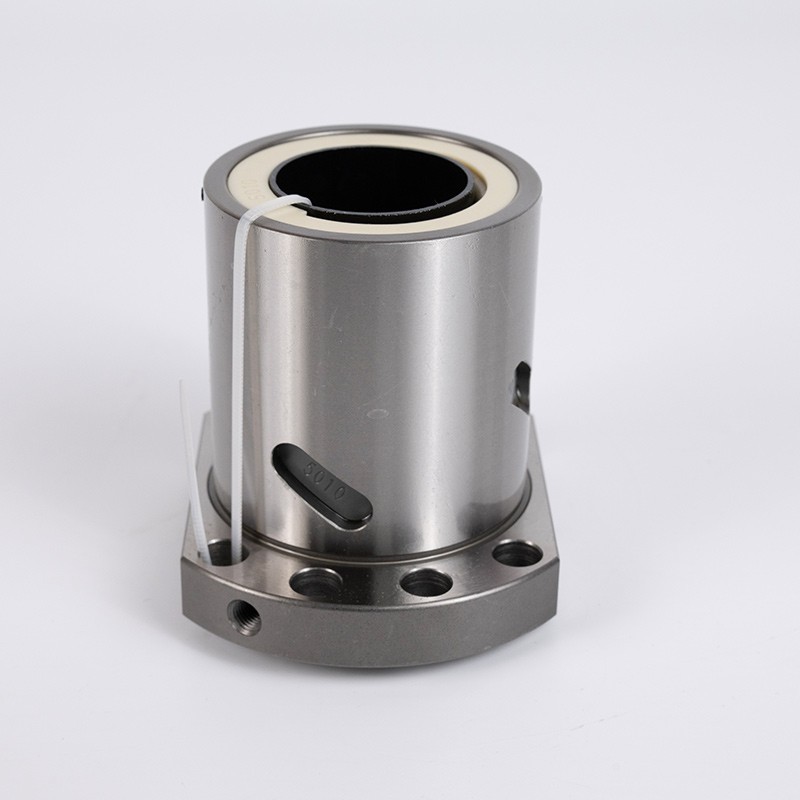

Waist-Type SFU Ball Nut
The waist-type SFU nut is a flanged single ball nut with two reduced side sections on its mounting flange. Viewed from the front, these reduced sections create a waist-shaped flange outline rather than a completely round profile.
The waist shape mainly affects the mounting envelope and flange interface. It does not represent an accuracy grade or a separate ball screw transmission principle. This nut type should be selected when the machine's nut seat, mounting plate or replacement space corresponds to its flange profile.
Reduced flange sides create a narrower mounting outline.
Compact single-nut structure for standard SFU screw combinations.
Model, flange dimensions and screw-shaft matching must all be checked.
Waist Flange and Installation Dimensions
A waist-type SFU nut should not be selected only by the nominal screw diameter and lead. Two nuts marked "1605" or "2005" may have different flange outlines, nut lengths, mounting-hole positions or ball return structures.
The following dimensions should be checked against the machine drawing or original nut:
| Symbol | Meaning | Why It Matters |
|---|---|---|
| d | Nominal screw diameter | Identifies the corresponding screw-shaft size. |
| l | Lead | Determines linear travel per screw revolution. |
| D | Nut body outside diameter | Must fit the nut housing or mounting bore. |
| A / W / H | Flange outline dimensions | Define the waist-shaped mounting envelope. |
| B | Flange thickness | Affects axial mounting position. |
| L | Overall nut length | Must fit the available axial installation space. |
| X | Mounting-hole diameter | Must correspond to the mounting bolts and hole positions. |
| Q | Lubrication-port thread | Used to confirm the lubrication connection. |
For example, the "12" in SFU1204 identifies a 12 mm nominal screw diameter. It is not the nut outside diameter. The corresponding nut body and flange dimensions must be read separately from the specification drawing.
Waist-Type SFU Nut Specifications
DLY supplies waist-type SFU nuts for multiple screw diameters, leads and circuit configurations. The original specification drawing below provides the detailed nut dimensions and load ratings.

Common models include:
| Screw Diameter | Typical Models | Available Leads |
|---|---|---|
| 12 mm | SFU1204-3 | 4 mm |
| 16 mm | SFU1604, SFU1605, SFU1610 | 4, 5, 10 mm |
| 20 mm | SFU2005, SFU2010 | 5, 10 mm |
| 25 mm | SFU2505, SFU2510 | 5, 10 mm |
| 32 mm | SFU3205, SFU3206, SFU3210 | 5, 6, 10 mm |
| 40 mm | SFU4005, SFU4010 | 5, 10 mm |
| 50 mm | SFU5005, SFU5010, SFU5020 | 5, 10, 20 mm |
| 63 mm | SFU6310, SFU6320 | 10, 20 mm |
| 80 mm | SFU8010, SFU8020 | 10, 20 mm |
| 100 mm | SFU10020-4 | 20 mm |
Model availability and nut dimensions should be confirmed before ordering. Suffixes such as -3, -4, -6 or -3/2 identify different circuit configurations and must not be omitted when matching a replacement nut.
Product Features and Applications
Defined Mounting Profile
The waist-shaped flange provides a different installation outline from a fully round flange. It is useful when the nut seat or surrounding machine structure is designed around the reduced flange sides.
Multiple SFU Specifications
Different nominal diameters, leads, nut lengths and circuit configurations are available. This allows the flange shape to be used across a broad range of standard SFU screw combinations.
Load and Stiffness Selection
Dynamic load rating, static load rating and stiffness differ by model and circuit configuration. These values should be checked together with the actual axial load, speed, stroke, duty cycle and required service life.
Typical Applications
Waist-type SFU nuts can be used in CNC equipment, automation machinery, linear modules, woodworking machinery, packaging equipment and replacement assemblies where the mounting interface corresponds to the waist-shaped flange.
Matching a Replacement SFU Nut
A new nut cannot be selected safely from the nominal diameter and lead alone. Even when two nuts share the same "1605" or "2510" designation, they may differ in body diameter, flange dimensions, overall length, circuit configuration and return-system clearance.
Please provide the following information when replacing an existing nut:
- Complete model number, including the circuit suffix.
- Nominal screw diameter and lead.
- Nut body and flange dimensions.
- Clear photos of the original nut and screw shaft.
- Condition of the existing screw raceway.
- Required quantity.
Ball tracks and ball sizes must match the actual screw shaft. A new nut should not be forced onto an old screw simply because the nominal diameter and lead appear identical.
Nut Material and Initial Machining

DLY commonly uses 20CrMo for the ball nut body. The manufacturing process includes blank preparation, turning, flange forming, internal and external diameter machining, mounting-hole processing and ball-raceway-related machining.
During initial machining, key dimensions such as the nut body diameter, flange thickness, overall length, mounting-hole position and lubrication-port position are checked against the corresponding model drawing.
Hole, Thread and Detail Machining

Mounting holes, lubrication ports, retaining features and related threads are processed according to the individual nut drawing. Thread size and position vary by model; smaller nuts commonly use M6 lubrication ports, while some larger models use M8.
Burrs and machining residue must be removed before ball assembly. Cleaning is especially important around blind holes, circulation passages, lubrication ports and retaining grooves.
Inspection During Production

- Check the raw material and blank before machining.
- Inspect the nut body, flange and mounting dimensions during production.
- Check holes, threads, edges and surface condition before assembly.
- Clean the nut and circulation passages before ball matching.
- Confirm the model, appearance and required dimensions before shipment.
The accuracy grade of a complete ball screw assembly depends on the screw shaft, nut matching and manufacturing method. A standalone replacement nut should therefore not be described as C3, C5 or C7 without considering the matching screw shaft.
Preventive Maintenance
Maintain a suitable lubricant film and prevent dust, chips, coolant residue or other contaminants from entering the ball tracks. Lubrication intervals should be determined according to speed, load, stroke, operating temperature, contamination level and lubricant type.
Avoid mixing incompatible greases. When changing lubricant type, clean the old lubricant according to the grease supplier's compatibility guidance.
Periodically check movement, noise, lubrication condition, axial clearance and mounting security. If abnormal resistance, vibration or increasing clearance is found, stop the system and inspect the nut, screw raceway, alignment and support arrangement.
DLY Supply and Support
- Waist-type SFU nuts in multiple diameter-and-lead combinations.
- MOQ starting from one piece for suitable standard products.
- Model, drawing and mounting-dimension confirmation.
- Nut and screw-shaft matching according to actual requirements.
- Production inspection and protective export packaging.
To compare complete screw-and-nut assemblies, view the SFU ball screw . For other nut structures, visit the DLY ball nut category .
FAQ About Waist-Type SFU Nuts
Q: What does "waist-type" mean?
A: It describes the flange outline. Two sides of the flange are reduced, producing a waist-shaped mounting profile rather than a fully round flange.
Q: Is a waist-type nut interchangeable with every SFU nut?
A: No. Screw diameter, lead, nut outside diameter, flange dimensions, overall length, mounting holes, circuit configuration and ball-track matching must correspond.
Q: Can I purchase only the replacement ball nut?
A: A nut-only order can be evaluated, but the existing screw shaft and original nut information must be checked. A nominally identical nut may not run correctly on an unmatched or worn screw shaft.
Q: How can I identify the screw diameter and lead?
A: The model number usually includes both values. For example, SFU1605 indicates a 16 mm nominal screw diameter and a 5 mm lead. Measure the actual components or provide the original model when identification is uncertain.
Q: Does the accuracy grade belong to the nut alone?
A: No. Lead accuracy applies to the complete ball screw assembly and depends mainly on the screw shaft, manufacturing method and nut matching. A separate nut cannot independently convert an existing screw into a higher accuracy grade.
Q: What information should I provide for a replacement nut?
A: Provide the complete nut model, screw diameter, lead, flange and nut dimensions, photos of the original parts, screw-shaft condition and required quantity.
Hot Tags: waist sfu nuts, China waist sfu nuts manufacturers, suppliers, factory, ball nuts climbing gear, SCM Nut, ball nut stopper, rotating ball nut design, ball nut, DFU Nuts


