


The size of a rotating ball nut affects its load capacity, rotating inertia, rigidity, heat generation and installation envelope. However, size alone does not determine whether a nut will operate faster, provide higher accuracy or deliver longer service life.
A rotating ball nut works with a ball screw shaft. The screw is prevented from rotating while the nut is driven by a motor through a pulley, gear or another transmission mechanism. Relative rotation between the nut and screw produces linear displacement.
When comparing rotating ball nut sizes, engineers should evaluate the complete assembly-including the screw shaft, nut raceways, support bearings, rotating housing and drive interface-rather than selecting only by nominal screw diameter.
What Does Rotating Ball Nut Size Include?
The "size" of a rotating ball nut may refer to several related dimensions and design parameters:
- Nominal screw shaft diameter
- Screw lead
- Ball nut outside diameter
- Nut body length
- Flange diameter and bolt pattern
- Ball diameter
- Number of ball circuits or effective turns
- Rotating housing and bearing dimensions
Two nuts with the same nominal screw diameter can have different load ratings, lengths, flange dimensions, circulation systems and preload conditions. It is therefore necessary to compare the manufacturer's complete specifications instead of assuming that all nuts of the same diameter perform identically.
1. Effect on Dynamic and Static Load Capacity
Larger rotating ball nut assemblies often have the potential to carry higher axial loads because they can incorporate larger raceways, larger balls or more effective load-carrying contacts. However, nominal diameter alone does not define the actual capacity.
Load rating is also influenced by:
- Ball diameter and number of loaded balls
- Number of effective ball circuits
- Raceway geometry
- Contact angle
- Nut length
- Material and heat treatment
- Manufacturing quality
- Single- or double-nut construction
- Preload method
The dynamic load rating is used when evaluating fatigue life under repeated operation. The static load rating is important when the assembly may experience high peak loads, emergency stops or shock.
A larger size should therefore be selected only after comparing its actual dynamic and static ratings with the application load cycle.
2. Effect on Axial Rigidity
Increasing the screw diameter and nut contact capacity can improve axial rigidity, but the stiffness of the complete system also depends on the screw shaft, nut, support bearings, housing and mounting structure.
A larger nut installed in a flexible housing will not automatically produce a rigid axis. Similarly, incorrect alignment, insufficient bearing support or a weak nut bracket can limit performance even when the ball nut itself has high rigidity.
Preload may reduce axial clearance and increase rigidity, but it also increases frictional torque and heat. The selected preload should match the required positioning response, load and operating speed.
3. Effect on Rotational Inertia
In a rotating-nut system, the ball nut, support bearings and drive components form part of the rotating mass. A larger assembly generally has greater rotational inertia.
Higher inertia can affect:
- Motor acceleration and deceleration torque
- Response during rapid direction changes
- Servo tuning
- Energy consumption during repeated cycles
- Emergency-stop load
This does not mean that a larger nut is always slow. A correctly sized motor may still accelerate it rapidly. It means that the additional rotating inertia must be included when selecting the motor and transmission ratio.
For equipment with frequent short strokes and reversals, inertia may be more important than it is on an axis that runs for long periods at a nearly constant speed.
4. Effect on Maximum Rotational Speed
It is inaccurate to assume that every small rotating ball nut can run faster than every large one. Maximum permissible speed depends on more than mass.
Important factors include:
- Nominal diameter and rotational speed
- Ball circulation design
- Ball velocity inside the return system
- Rotating-nut support bearings
- Lubricant type and delivery method
- Seal friction
- Balance of the rotating assembly
- Preload and operating temperature
A larger diameter increases the surface speed of rotating components at the same rpm. It may also raise the demands on balancing and lubrication. Nevertheless, the permitted speed must be taken from the specifications of the actual nut assembly rather than estimated from its external dimensions.
5. Effect on Linear Speed
Linear speed is determined mainly by nut rotational speed and screw lead:
Linear speed = rotational speed × lead
For example, two rotating ball nuts of different diameters will produce the same theoretical linear speed if they operate at the same rpm and use the same lead.
A larger nut does not automatically produce higher or lower linear speed. The result depends on the available lead, permissible nut speed and drive-system capability.
6. Effect on Driving Torque
The torque required to drive a rotating ball nut is affected by axial load, screw lead, transmission efficiency, preload, seal resistance and acceleration of the rotating components.
A larger nut may require additional acceleration torque because of its higher inertia. It may also have higher seal and preload resistance. On the other hand, selecting a larger size may provide the load capacity and rigidity required for the application.
The motor should be checked for both:
- Continuous torque during normal travel
- Peak torque during acceleration, deceleration and reversal
Motor selection based only on steady running torque can result in insufficient acceleration performance.
7. Effect on Heat Generation
Heat is not determined by nut size alone. It is affected by rotational speed, preload, lubrication, seals, alignment and duty cycle.
A larger rotating assembly may generate more bearing and seal losses, while a smaller nut operated close to its maximum speed can also experience substantial temperature rise.
Excessive temperature can change preload, lubricant viscosity and thermal expansion within the assembly. For continuous or high-speed operation, the expected temperature rise should be evaluated under actual load and lubrication conditions.
8. Size Does Not Directly Determine Accuracy
One of the most important corrections to the original article is that a smaller ball nut is not automatically more accurate or lower in backlash.
Positioning performance depends primarily on:
- Ball screw lead accuracy
- Axial clearance or preload
- Manufacturing consistency
- Support-bearing rigidity
- Housing concentricity
- Thermal expansion
- Installation alignment
- Servo feedback and control
A larger precision-ground, preloaded assembly can provide better positioning performance than a smaller rolled ball screw with axial clearance. Size and accuracy should therefore be specified separately.
9. Effect on Installation Space
A larger rotating ball nut needs more than additional clearance around the nut body. The machine must also accommodate:
- Rotating-nut support bearings
- Bearing housing
- Pulley, gear or direct-drive interface
- Belt clearance and tensioning space
- Lubrication inlet
- Seals and protective covers
- Assembly and maintenance access
A compact nut may help reduce the overall installation envelope, but selecting a size that is too small can leave insufficient load capacity, rigidity or bearing life.
Examples of Different Ball Nut Sizes

A 1605 ball nut designation generally refers to a 16 mm nominal screw diameter and 5 mm lead.
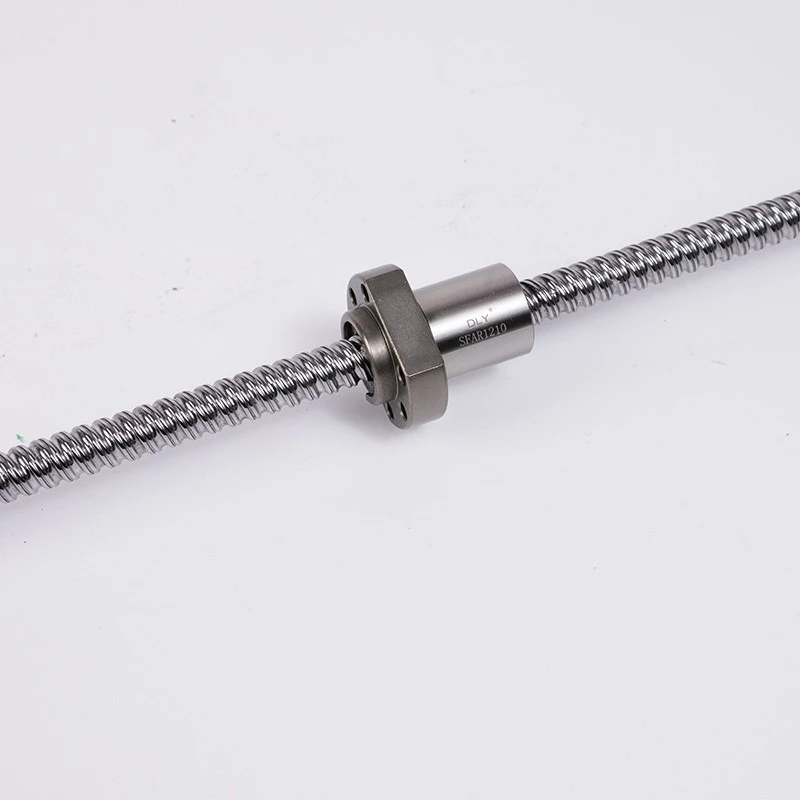
A 1204 ball nut designation generally refers to a 12 mm nominal screw diameter and 4 mm lead.
The images show different ball nut sizes, but the nominal model designation alone does not confirm that a nut is supplied as a complete rotating-nut assembly. The bearing housing, drive interface and permitted rotating speed must be reviewed separately.
Rotating Ball Nut Size Comparison
| Performance factor | Effect of increasing size | What must still be verified |
|---|---|---|
| Load capacity | Often increases | Actual Ca and Coa ratings, circuits and raceway design |
| Axial rigidity | May increase | Preload, shaft stiffness, bearings and housing |
| Rotational inertia | Generally increases | Complete rotating assembly and motor acceleration torque |
| Maximum speed | Cannot be determined by size alone | Permitted rpm, circulation design, bearings and lubrication |
| Accuracy | No direct relationship | Lead accuracy, preload, alignment and thermal error |
| Installation space | Increases | Housing, pulley, bearings and maintenance clearance |
| Cost | May increase | Accuracy, preload, machining and assembly complexity |
How to Select the Appropriate Size
Before selecting a rotating ball nut size, provide the following application information:
- Required travel and total screw length
- Maximum and average axial load
- Maximum linear speed
- Acceleration and deceleration
- Operating cycle and daily running time
- Required accuracy and repeatability
- Acceptable axial clearance
- Installation orientation
- Available housing and drive space
- Lubrication and environmental conditions
The smallest nut that fits the available space is not necessarily the most economical choice if it operates too close to its load or speed limits. Likewise, an unnecessarily large assembly can increase inertia, motor requirements and installation cost without improving accuracy.
Conclusion
Rotating ball nut size has a meaningful influence on load capacity, rigidity, inertia, temperature and installation space. Its effect on speed, accuracy and service life is less direct and must be evaluated using the specifications of the actual nut, screw shaft, bearings and housing.
DLY supplies multiple ball nut series and compatible ball screw assemblies. For a rotating-nut project, send the required load, travel, speed, accuracy and installation drawing so the complete configuration can be reviewed.


